
Sunflower Parole and Probation Differences
Parole and probation can both place a person in the community, but they begin in different ways. The MDOC supervision overview says probation is imposed by a court as an alternative to incarceration or as part of a judgment. Parole permits an eligible state prisoner to serve part of a prison sentence under conditions outside the institution. The Mississippi State Parole Board makes the parole decision. MDOC Community Corrections then performs field supervision.
Earned Release Supervision, often called ERS, is another conditional route. The person keeps inmate status and remains under MDOC jurisdiction until the sentence expires. Interstate Compact supervision may move an approved case across state lines. These distinctions matter when a Sunflower County parole or probation record is read. Release from a prison building may still leave a state sentence active, while a final discharge ends the sentence obligation described in the discharge record.
| Status | Who authorizes it | What it means |
|---|---|---|
| Parole | Mississippi State Parole Board | Conditional release from prison before the terminal sentence date. |
| Probation | Sentencing court | Community supervision ordered instead of, or as part of, confinement. |
| ERS | MDOC under state law | Conditional release while inmate status and MDOC jurisdiction continue. |
| Discharge | Custodian after sentence completion | Completion of the sentence obligation shown by the official record. |
- Parole
- Conditional community release granted through the state parole system.
- Probation
- Court-ordered supervision that may replace or follow confinement.
- Absconder
- A person whom the supervising authority cannot maintain required contact with.
- Revocation
- A formal process that may return a supervised person to custody after a violation.
Verify Sunflower Post-Release Supervision
The best public starting point for active parole is the official MDOC Parolee Search. Its fields include first name, last name, MDOC ID, city, and county. It is not a complete public probationer database. No official statewide public probation search was found in the research, so a failed parolee search cannot resolve probation status.
Use a statewide search even when Sunflower County is the main connection. A person convicted in Sunflower County may report where an approved home is located. Someone convicted elsewhere may report in Indianola. Interstate Compact can also place a Mississippi case outside the state or bring another state's case into Mississippi. An MDOC number is more reliable than a name alone.
- Search the parolee registry by MDOC ID when known, then try the exact booked name.
- Compare city, county, identity, and offense-related details. Do not select a record on name alone.
- Check the MDOC institutional search if prison custody or a transfer is still possible.
- Call the proper Community Corrections office to clarify active reporting when the public result is unclear.
- Ask MDOC Records for discharge documentation when the question is whether all supervision ended.
The broader Sunflower County release search explains how sheriff, court, and MDOC records fit together on the home page. That distinction is essential for someone who left the county jail without ever entering state custody.
Sunflower Supervision Office Route
MDOC maintains a dedicated local field office. The Sunflower Probation & Parole Office is the concrete contact for a person whose approved supervision placement is in the county. The location of Parchman or the county of conviction does not by itself select the reporting office.
Sunflower Probation & Parole Office122 Main Street
Indianola, MS 38751
Phone: 662-843-0028
Fax: 662-843-0137
The official office page does not publish walk-in hours, agent names, check-in instructions, or a promise about what staff will disclose. Call first and ask what identifying details are needed. For an unresolved location, the statewide Community Corrections office map helps locate another field office.
The official local-office screen provides the most direct visual reference. View the MDOC Sunflower office source before relying on copied contact information.
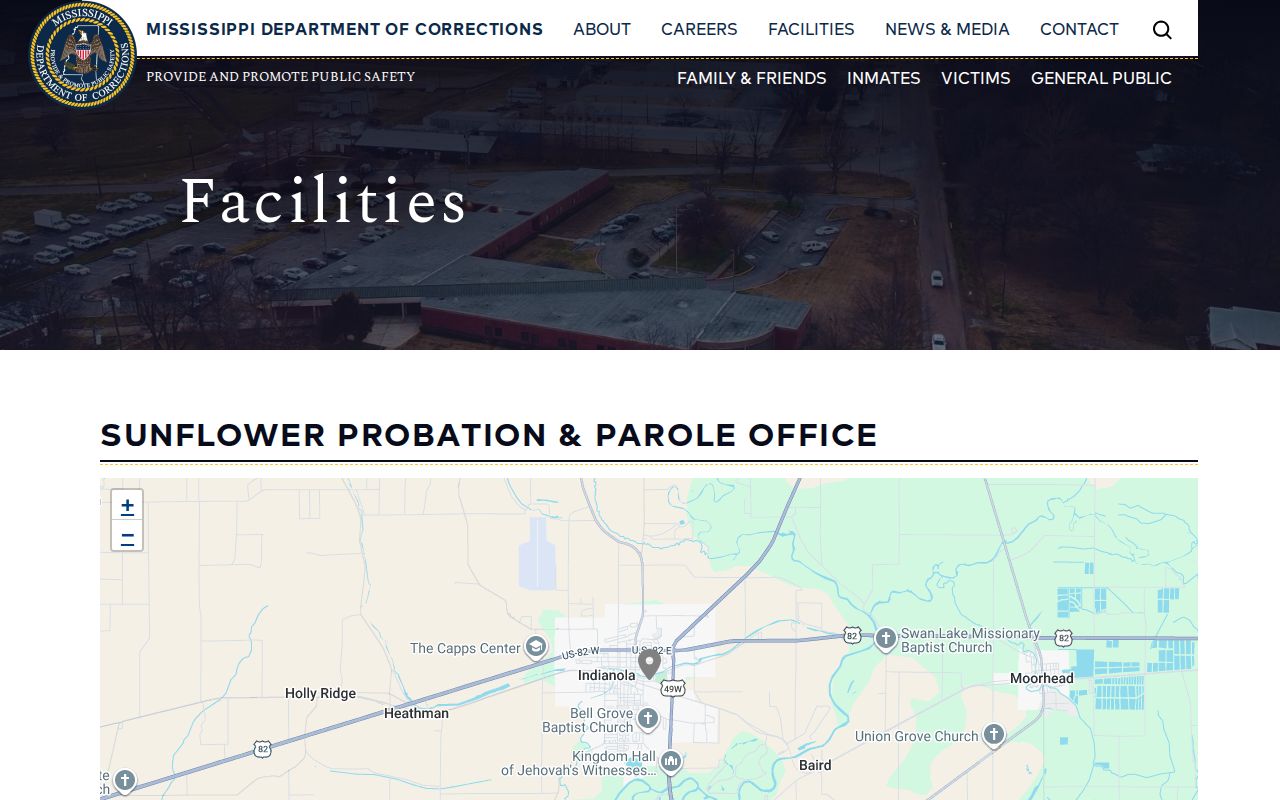
The MDOC page ties the Indianola address to Community Corrections, but the agency must still identify the office assigned to a specific supervision case.
Sunflower Parole Hearing Records
The Mississippi State Parole Board is separate from MDOC. The Board grants, denies, or revokes parole, while Community Corrections supervises a person after release. Official guidance says eligible cases are considered on a monthly basis in advance of the parole-eligibility date. No official public named-person calendar or person-level decisions search was found.
For a particular Sunflower County parole matter, contact the Board with the full name, MDOC number, birth date, and approximate eligibility or hearing month. Ask whether action occurred and request the releasable official action. Mississippi law requires the Board to keep copies of official actions and reasons in minute-book form. A grant does not prove same-day physical release. Address approval, detainers, eligibility timing, and processing may still stand between the decision and the prison gate.
Mississippi State Parole Board239 North Lamar Street, Suite 501
Jackson, MS 39202
Phone: 601-576-3520
Email: MSStateParoleBoard@mdoc.state.ms.us
MDOC Records is the better route for sentence credit, time computation, and proof that a discharge or physical release actually occurred.
Sunflower Supervision Violations
A technical violation is a claimed breach of a supervision condition rather than a new conviction. A revocation process may return a parolee, probationer, or ERS participant to custody. An absconder label generally means the agency cannot maintain required contact. These terms should not be inferred from a search miss.
No verified Sunflower County or statewide public MDOC absconder list was found. There is also no complete public probationer search. If active custody may have resumed, check the holding agency and related court or revocation record. If the person remains in the community, the assigned Community Corrections office is the source for status that can lawfully be confirmed. A warrant, violation report, and revocation order are different records and may carry different access limits.
Mississippi SAVIN can issue events for return to custody and abscond supervision when the reporting agency supplies them. Such an alert is a prompt to verify, not a certified warrant record.
Note: A missing parolee result may reflect discharge, spelling, location, or data timing and does not by itself establish a violation.
Sunflower Parole Reentry Preparation
Parchman has documented local release preparation through the Statewide Prison Reentry Academy. MDOC programming includes help with documents and resources, life skills, and coordination with Community Corrections. Those services can prepare a person for the move from prison custody into parole, ERS, or another approved status.
Program completion is not release proof. It does not show that the Parole Board granted parole, that a detainer cleared, or that MDOC issued a discharge certificate. Verify the actual change through the offender file, MDOC Records, and the assigned field office. Reentry work and legal custody status answer different questions, even when they occur close together.
The distinction is especially important in Sunflower County because Mississippi State Penitentiary is a state reception and classification point. A move away from Parchman can be a transfer within MDOC rather than a community release.
Sunflower Release Property Questions
The Sunflower County Sheriff's property page publishes rules for items brought into the jail. The official county listing identifies Sheriff James Haywood as the local sheriff. The property rules limit specified clothing and books to the first fourteen days and list a bonding-window delivery period on Wednesday and Sunday. Those are intake and delivery rules, not a published release-property procedure.
No official source reviewed states how clothing, identification, money, or unclaimed property is returned when a person leaves the Sunflower County Jail. Call the jail before making a trip. Do not assume the bonding-window schedule also governs release pickup. For someone leaving MDOC custody, the case manager and institution follow a different state-prison release process.
This local gap matters during supervision intake. Identification and release papers may be needed for agency contact, but only the releasing facility can explain its property process. The field office should not be treated as the custodian of items left at the jail.
Sunflower Supervision Discharge Proof
Supervision ends through the governing sentence or court process, not because a public name disappears. Mississippi law requires removal from the central parolee registry when parole or flat-time ends, so a later negative search may be consistent with completion. It is not a historical certificate.
Ask MDOC Records for the actual discharge date and releasable discharge material. A focused request should include the full name, MDOC number if known, birth date, conviction county, and the time period. If probation came from a court judgment, obtain the sentencing order and any later order showing completion, revocation, or modification. Pair the legal order with MDOC confirmation when Community Corrections handled the case.
When sources conflict, identify what each one proves. A court order controls the legal terms, a Board action records a parole decision, Community Corrections identifies field supervision, and MDOC Records confirms the state sentence history. One document should not be made to answer every part of the Sunflower County supervision question.
A completed sentence differs from release on parole or ERS. The first ends the obligation shown by the record. The others shift the place and form of custody while conditions remain. That final distinction prevents an active Sunflower County supervision case from being mistaken for full discharge.